
Concussion Care, Even After Leaving the Olympic Village
March 3, 2026
June is PTSD Awareness Month
June 3, 2026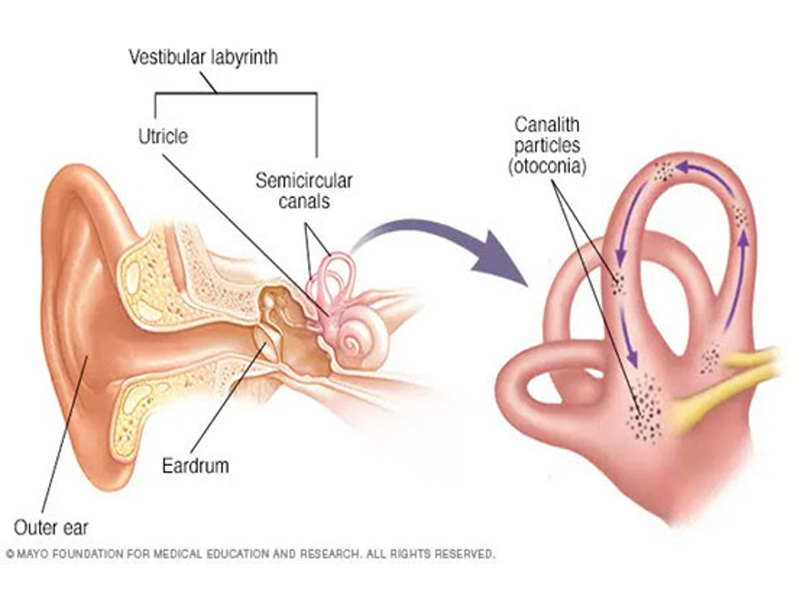
Science Corner April 2026
Do you suffer from dizziness, unsteadiness, or feeling off-balance after a TBI? Many people assume that these symptoms mean something is wrong with their brain, and while that is understandable, the culprit is sometimes much closer to your ear. The good news? This type of dizziness may not be a brain problem at all. It may be coming from a tiny crystal that has slipped out of place inside your inner ear, and it is often very treatable.
First, let’s learn more about the anatomy of the ear:
Your ear does more than just hear sounds; it also helps you keep your balance. Deep inside your ear is a system called the inner ear, which has two very important parts.
The first part is the semicircular canals, three tiny loop-shaped tubes filled with fluid. When you move your head, the fluid shifts and brushes against tiny hair-like sensors that send signals to your brain, telling it exactly how your head is moving.
The second part is called the utricle, a small pouch sitting next to the semicircular canals. Inside it, tiny calcium crystals called otoconia rest on a jelly-like layer, helping your brain sense gravity so you always know which way is up.
Normally, these crystals stay right where they belong. But they can break loose and drift into the semicircular canals, where they do not belong, sending confusing signals to your brain and causing something called BPPV.
1. What Is BPPV?
BPPV stands for Benign Paroxysmal Positional Vertigo. It is the most common inner-ear disorder after a head injury. When crystals become dislodged, even a slight head movement can send incorrect signals to your brain, triggering dizziness or vertigo (feeling like you or the room is spinning). This may occur following a head injury or without an identifiable cause. When you experience BPPV, even a slight head movement can send the wrong signal to your brain.
Common symptoms include:
Feeling like you or the room is spinning (vertigo)
Feeling unsteady or off-balance
Feeling dizzy when you lie down, turn over in bed, or tilt your head
Eyes moving on their own, called nystagmus
2. What to Know About BPPV After a Brain Injury
If you or someone you know has had a traumatic brain injury (TBI), there is a chance BPPV could develop. About half of all people with a TBI have dizziness and balance problems at some point during recovery; BPPV is a common cause.
How Common Is It?
A research study followed 117 patients who had head injuries of different severities. The results showed that about 1 in 5 patients (21%) developed BPPV within 3 months of their injury. The likelihood of developing BPPV increases with the severity of head injury.
When Does It Start?
Most cases of BPPV after a head injury start very quickly. In the research study, most people developed symptoms within the first two weeks after their injury. In fact, a large portion of cases began within the first few days. The very first dizzy spell often happens when someone turns over or sits up in bed, because lying down is when the displaced crystals are most likely to shift into the wrong canal.
Why Does a TBI Cause BPPV?
When your head experiences a significant force, whether from a direct blow, a fall, a car accident, or even rapid acceleration and deceleration, it can dislodge the tiny crystals in your inner ear. It can also develop after whiplash-type injuries, sports collisions, or any event that causes the head to move suddenly and forcefully, even without direct contact.
Balance problems after a TBI can also come from other causes. That is why it is important to see a doctor who can figure out exactly what is causing your dizziness.
3. What to Do If You Experience BPPV
See a Doctor: If you feel dizzy or like the room is spinning after a head injury, tell your doctor right away. To diagnose BPPV, a doctor will move your head into different positions and watch your eye movements.
Treatment: The Canalith Repositioning Procedure: The good news is that BPPV is very treatable! The most common treatment is called the canalith repositioning procedure. A healthcare provider (most commonly a physician or a physical therapist) will guide you through a series of slow, simple head movements. The goal is to gently move the loose crystals out of the incorrect canal and back to their proper location. This treatment often works after just one or two sessions, and your doctor can also show you how to do it at home.
In rare cases where this procedure is ineffective, surgery may be considered, but this is uncommon. BPPV may also go away on its own within a few weeks or months.