
Built to Keep Going: Jordan Slade’s Journey
There are people who survive hardship, and then there are people who allow hardship to become part of the architecture of who they are.
Jordan Slade is one of those people.
Born in Florida and now living in Raleigh, North Carolina, after spending years moving around the country, Jordan has experienced more than one chapter of adversity. After a tumultuous childhood and young adulthood, he learned early on that life can change without warning, and that sometimes survival means learning how to keep moving forward anyway.
That resilience would be tested time and time again.
Jordan was on his way to work when his tire blew out. His vehicle struck a telephone pole before crashing into an abandoned home. He remained unconscious inside the vehicle for approximately three hours before being found and transported to the ICU, where he was in a coma with a severe traumatic brain injury.
While Jordan was fighting for his life, his family was caring for his children.
His children would become one of the most powerful forces in his recovery.
For Jordan, recovery has never been simply about returning to the person he was before his injury. It has been about learning how to live fully within the life he has now, and building that life around the people he loves.
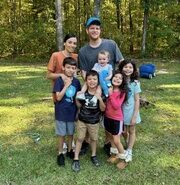
His children remain a constant source of motivation. They remind him why the work matters on the days when recovery is exhausting, frustrating, or uncertain. They are part of the reason he continues to push himself to adapt, grow, and find new ways forward.
But Jordan’s recovery has also revealed something deeper: his determination is not limited to his own healing.
He has taken his fierce will to survive and turned it outward.
Jordan has immersed himself in the brain injury community, becoming a passionate supporter of survivors, support groups, rehabilitation hospitals, and efforts to make life after brain injury more navigable.
His entrepreneurial spirit has led him to create Survivor & System Solutions, a consulting firm designed to help survivors be better understood and to implement accommodations for people living with brain injuries. The organization helps healthcare operations, tech providers, and agencies improve cognitive accessibility, crisis response, and coordination for traumatic brain injury survivors.
For Jordan, advocacy is personal. Survivors are returning to workplaces, families, communities, and responsibilities that do not always understand how profoundly a brain injury can affect a person’s life. He wants to help bridge that gap.
He also believes strongly in the mental component of healing. Jordan recognizes the role his own determination has played in survival and recovery, while acknowledging that healing involves more than the physical brain. It also involves adapting emotionally and psychologically to a life that may look very different than the one imagined before injury.
Jordan is also passionate about the potential benefits of medical cannabis and about creating open conversations around treatment and recovery options for survivors.
Jordan’s advocacy does not stop with his own story.
He uses his natural networking abilities to bring people together and create opportunities within the TBI community. Most recently, he helped create the Brain Summit, connecting people around brain injury awareness, education, advocacy, and community.
That work matters because brain injury can be profoundly isolating.
Jordan understands the importance of finding people who don’t require a survivor to explain every invisible part of their experience before they can be understood.
One of the most powerful parts of Jordan’s story is that he does not define survival as the absence of struggle.
His life has taught him that hardship cannot always be avoided. Sometimes survival means learning how to adapt to what happened and continuing forward when the path is unclear.
As Jordan puts it:
“Survival is not about escaping every hardship, it is about learning how to adapt when life changes, overcome what was meant to break you, and continue forward even when the path is unclear.”
He understands that progress is not always dramatic. “Some days, progress is measured in miles. Other days, it is measured by simply refusing to give up.”
That perspective is at the heart of Jordan’s journey.
His story is not about conquering adversity once and leaving it behind. It is about repeated adaptation, surviving his childhood, building a family, surviving a devastating brain injury, and then using what he has learned to help others navigate their own difficult roads.
That is what makes his story so powerful.
Flourishing after brain injury does not necessarily mean getting everything back. Sometimes it means discovering strengths you did not know you possessed. Sometimes it means finding purpose in what happened to you. And sometimes it means looking at an uncertain road ahead and deciding to take the next step anyway.
Jordan has chosen that step again and again, for himself, for his family, and for the larger community of survivors he has made part of his life’s work.
His message is simple:
“Every step matters. Every step creates momentum.”
For the survivor having a good day, his words are encouragement to keep going. For the survivor having a difficult time, it is permission to redefine what progress looks like. Jordan’s story is a reminder that survival is not the end of the story. Sometimes, survival is where the next chapter begins.
“Keep on keepin’ on, Survivors, because the strength carrying you forward was built through everything you have already survived.”