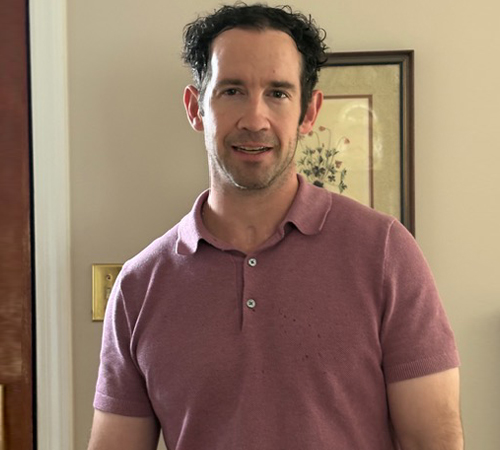
Bill Houck ’s Journey
In 2013, Bill Houck was a recent pre-med graduate with a plan. He was preparing to take the MCAT and imagined a future in healthcare. He had spent years working toward that future, believing he knew what the next chapter of his life would look like.
Then, a severe car accident changed the trajectory of his life.
Bill was a passenger in the vehicle and was ejected in the crash, sustaining a severe traumatic brain injury. He was emergently hospitalized with a Glasgow Coma Scale score of three. His injuries also included liver and kidney lacerations and rib fractures. He underwent surgery to relieve pressure from his brain hematoma and required a ventilator and tracheostomy. He remained in a coma for approximately a month.
After intermediate care, Bill entered inpatient rehabilitation, where his memories first began to return. He remembers waking profoundly confused, initially believing he was back at college and that his family had somehow orchestrated an elaborate joke. Soon, however, confusion gave way to determination.
Wheelchair-bound and with part of his left leg still unable to function, Bill faced the enormous task of relearning what his injury had taken from him. It would be a long and difficult road, but his family and friends remained beside him.
The future he had been preparing for no longer looked quite the same.
Bill tried returning to school several times, but found the cognitive demands overwhelming. Eventually, he earned a certificate in phlebotomy and later completed a neuroscience program at the University of Pennsylvania. His path into healthcare did not disappear. It simply became different.
Perhaps Bill was uniquely prepared for that kind of redirection. His brain injury was not his first experience with surviving something unexpected. At 17, he underwent heart surgery after a previous car accident caused a torn aorta. He describes that experience almost casually now, calling it a “cake walk compared to brain injury.”
Bill has been living independently for several years, but independence did not mean his recovery was finished. He continues to work diligently every day to improve cognitively, understanding that rebuilding after brain injury can be slow, demanding, and largely invisible.
His approach is surprisingly uncomplicated. Bill does not chase recovery with relentless pressure. Instead, he takes a relaxed, low-key approach, giving himself time to focus on what matters.
There is something quietly powerful about that philosophy. Recovery is hard enough without turning it into another source of pressure.
For several years, Bill has worked at Success Rehabilitation as a Direct Support Professional in a permanent care residence, supporting individuals with more significant impairments. His clients do not know that he is a brain injury survivor himself. Bill knows, and that changes the way he sees his work.
He finds it deeply rewarding to support people whose lives have been profoundly altered by neurological injury. His own experience allows him to connect with them in ways that can be difficult to replicate without lived experience. He considers the people he cares for his “brain injured family.”
There is a quiet symmetry to his story. Bill once imagined entering healthcare to help patients. Today, he is doing exactly that, just not in the way the younger version of himself expected.
The road to employment was not always easy. Bill was let go from two jobs after his brain injury when employers struggled to understand his disability and the accommodations he needed. Those experiences could have become evidence of everything he had lost. Instead, they became part of the longer process of discovering what he could do and where he belonged.
Today, his life includes work, independence, continued cognitive recovery, and adventure. Bill has traveled to Iceland, England, and Belgium and explored places throughout the United States, including Wyoming, Montana, and Mount Rushmore. He often travels with his mother, and those trips have created a deeper connection between them.
Both of Bill’s parents have been integral to his recovery. His experience has given him a profound appreciation for the relationships that sustain survivors through the years after injury.
There are times when survivors can feel disconnected from other people, as though the world continues moving around them while they are trying to find their way back into it. For Bill, being around other survivors provides something difficult to replicate elsewhere: recognition without explanation.
Most importantly, Bill has learned not to measure recovery by how quickly he can become who he once was.
Sometimes flourishing is quieter and more powerful than that.
Sometimes it looks like getting up, going to work, continuing the cognitive work, taking the pressure off, and allowing yourself enough time to become whoever you are now.
Bill Houck’s story is a reminder that there is no single blueprint for life after brain injury. The road may not lead where you originally intended to go, but that does not mean it cannot lead somewhere meaningful.
Sometimes the most remarkable recovery is not the life you return to. It is the life you patiently build instead.